KJSEA
Your child got an “E” on KJSEA — before you panic, read this
An “E” on the KJSEA slip is a signal about a learning area — not a verdict that your child’s future just ended in the sitting room.
Last updated: 6 September 2026
An “E” on the KJSEA slip is a signal about a learning area — not a verdict that your child’s future just ended in the sitting room.
The slip arrives. Someone says “E.” Your stomach drops. A relative starts a speech about “nowadays children.” Another relative starts a speech about private school. You have not yet asked which learning area, which sub-level, or what the school’s briefing actually said.
Panic is loud. It is also expensive. It buys the wrong pamphlets, starts the wrong comparisons, and teaches the child that one band equals their whole worth. This page is the opposite of that night: decode first, plan second, shop last.
Hero — Kenyan parent and Grade 9 learner reviewing a results slip / workbook at a kitchen table; empathy not punishment; warm evening light; phone face-down; studio photography $10k bar; no AI-slop; no readable personal marks or fake school stamps.
The straight answer
What does an “E” on KJSEA mean? Public explainers summarizing KNEC-style reporting describe four bands — Exceeding (EE), Meeting (ME), Approaching (AE), Below (BE) — each with sub-levels and points out of 8 per learning area (often discussed against a 72-point language across nine areas). An E-looking code on a slip is about that learning area’s performance descriptor, not a newspaper failure stamp. Placement talk commonly uses a composite picture of roughly 60% KJSEA + 20% KPSEA + 20% SBA. Do not invent pathway cut-scores. Name the weak area, run a short diagnostic, repair with marked practice, protect sleep, and ask the school how they will brief pathway options. Re-verify descriptors and weights against school/KNEC materials at decision time.
For the broader Grade 9 calendar and calm revision frame, keep the KJSEA Grade 9 parents’ guide open beside this piece. This article is the “E” decoder and the recovery week — not a fake cut-score table.
Sit down. Put the phone face-down.
First 48 hours: no ripping slips, no sibling ranking, no buying every pamphlet in town.
Read the slip with the child, not at the child. One sentence only: “This is a signal. We will map it.”
If Form 4 or Grade 6 also live here, separate their jobs — three exam classes under one roof. Tonight is not a household ranking meeting.
Decode the letters before you punish the child
Public explainers summarizing KJSEA reporting describe an 8-level scale per learning area. Schools issue slips with descriptors in this family. Use the slip your school gives you as the source of truth; do not trust a forwarded WhatsApp graphic over the paper in your hand.
| Band | Levels (common codes) | Points per learning area (as widely reported) |
|---|---|---|
| Exceeding Expectation | EE1, EE2 | 8, 7 |
| Meeting Expectation | ME1, ME2 | 6, 5 |
| Approaching Expectation | AE1, AE2 | 4, 3 |
| Below Expectation | BE1, BE2 | 2, 1 |
Nine learning areas × a maximum of 8 points is commonly described as a 72-point ceiling for the KJSEA aggregate language on the slip. That KJSEA picture then feeds the 60% slice of the wider placement score in the widely reported composite — alongside KPSEA (~20%) and school-based assessment (~20%).
What “E” usually means in parent talk
Parents often say “E” as shorthand for a scary letter on the slip — sometimes meaning Exceeding, sometimes meaning a low band that “looks like failure,” sometimes mixing old KCPE letter habits with new CBC descriptors. Before you react:
- Read the full code on the slip (EE1, ME2, AE1, BE2, or whatever your school printed).
- Name the learning area (Mathematics? Integrated Science? Languages?).
- Ask whether the speech is about one area or the whole aggregate.
- Ask the school how they will interpret the slip for pathway briefing — not a neighbour who sat KCPE in another decade.
An Exceeding band is not a problem to solve. A Below or Approaching band is a map. Neither is a personality.
BE/E on a strand means that strand needs repair — not that STEM is “dead” forever.
The composite: why one letter is not the whole story
| Piece | When it is earned | Widely reported share |
|---|---|---|
| KPSEA | Grade 6 | ~20% |
| School-based assessment (SBA) | Commonly described across Grades 7–8 | ~20% |
| KJSEA | Grade 9 | ~60% |
Attribute this pattern to public placement explainers. Re-verify against KNEC/MoE primary pages and your school’s briefing before you make money or school-choice decisions. We are not inventing a ministry circular or pathway cut-scores here. Thresholds and school categories shift with policy and year; ask the school how they will brief parents when options are discussed.
Why this matters on an “E” night: a soft learning area hurts, especially inside the large KJSEA slice — but KPSEA is already banked, SBA patterns already exist, and other learning areas on the same slip may be stronger. The job is a profile, not a single letter used as a weapon.
If Grade 6 was ignored because someone said it was “just monitoring,” that history matters too — see KPSEA isn’t just monitoring. You cannot rewrite Grade 6 tonight. You can still refuse to waste Grade 9’s remaining runway on panic.
Pathways: honest without inventing cut-scores
KJSEA feeds Senior School pathway placement conversations — commonly discussed as STEM, Social Sciences, and Arts and Sports Science — based on combined performance and strengths across learning areas. That is placement language, not a pass-or-fail life sentence.
What this page will not do:
- Invent cut-scores for pathways or school categories.
- Quote a fake ministry threshold.
- Tell you your child “must” enter a named school because of one band.
- Pretend an app can pick schools for you.
Kitabu does not pick schools. STEM / Social / Arts — ask the school; don’t invent cut-scores from a forwarded PDF.
What you can do this week:
- Ask the school for the official briefing timeline.
- List the child’s stronger learning areas beside the weak ones.
- Separate “this strand needs repair” from “this child has no future.”
- Keep sleep, food, and calm as non-negotiables while you wait for school guidance.
A 7-day recovery that is spicy-safe, not reckless
This is not a miracle week. It is a refusal to spiral.
In-body — one-subject recovery desk: past paper + pencil + short handwritten 7-day checklist on a Kenyan homework table; calm focus; studio $10k bar; no AI-slop; no fake KNEC paper photography.
Day 1 — Decode and cool the house
- Read the slip with the child, not at the child.
- Write down: learning area, code/band, what the child already knows felt hard.
- Ban sibling comparison for seven days.
- One sentence only: “This is a signal. We will map it.”
Day 2 — Diagnostic before shopping
- Short diagnostic on the weak learning area (and the strand under it).
- If maths is the tear, gaps often sit in earlier fractions or place value — child failing maths.
- Do not buy five new books until the gap has a name.
Day 3–4 — Repair loop, not volume theatre
- 25–40 focused minutes on the named strand.
- Teach-back in English or Kiswahili — whichever lands.
- One past-paper section, marked the same day.
- Mistake log: what went wrong in one plain line.
- Method: past papers after the red ink.
Day 5 — Evidence check for the parent
- Replace umesoma? with: What strand? What artifact? What is still stuck?
- Use a dashboard or Friday-style update habit — parent progress updates and is my child really revising.
Friday WhatsApp beats a week of interrogation after red ink.
Day 6 — School channel, not rumour channel
- Message or visit through the school’s named channel.
- Ask how pathway briefing will work and what the slip’s descriptors mean in their language.
- Ignore cut-score rumours in parent groups.
Day 7 — Reset the household OS
- Protect one rest block.
- Plan the next two weeks: three weak-strand sessions + one marked section each weekend.
- Praise a repaired mistake out loud. Do not praise panic.
If holidays interrupt, keep skills warm rather than restarting from shame — holiday revision Kenya.
What not to do on an “E” night
| Panic move | Better move |
|---|---|
| “You have failed life” speech | “This learning area needs a map” |
| Comparing to a cousin with EE everywhere | Separate children, separate slips |
| Buying every pamphlet before diagnosis | Name the strand first |
| Inventing a cut-score from WhatsApp | Wait for school/KNEC briefing |
| Cutting sleep for “revenge papers” | Shorter marked practice + sleep |
| Hiding the slip from the child forever | Decode together, then plan |
Spicy-safe means you can be honest — “this band is below where we hoped” — without being reckless with a child’s dignity.
Pick the tear subject, run a diagnostic, practise with teach-back — tu.
Sibling links for the wider exam season
- Grade 6 composite myth-bust: KPSEA isn’t just monitoring
- Form 4 parent dashboard language: stop asking umesoma
- Household with three exam classes: three exam classes under one roof
- After red ink on any paper set: past papers after the red ink
Where Kitabu fits
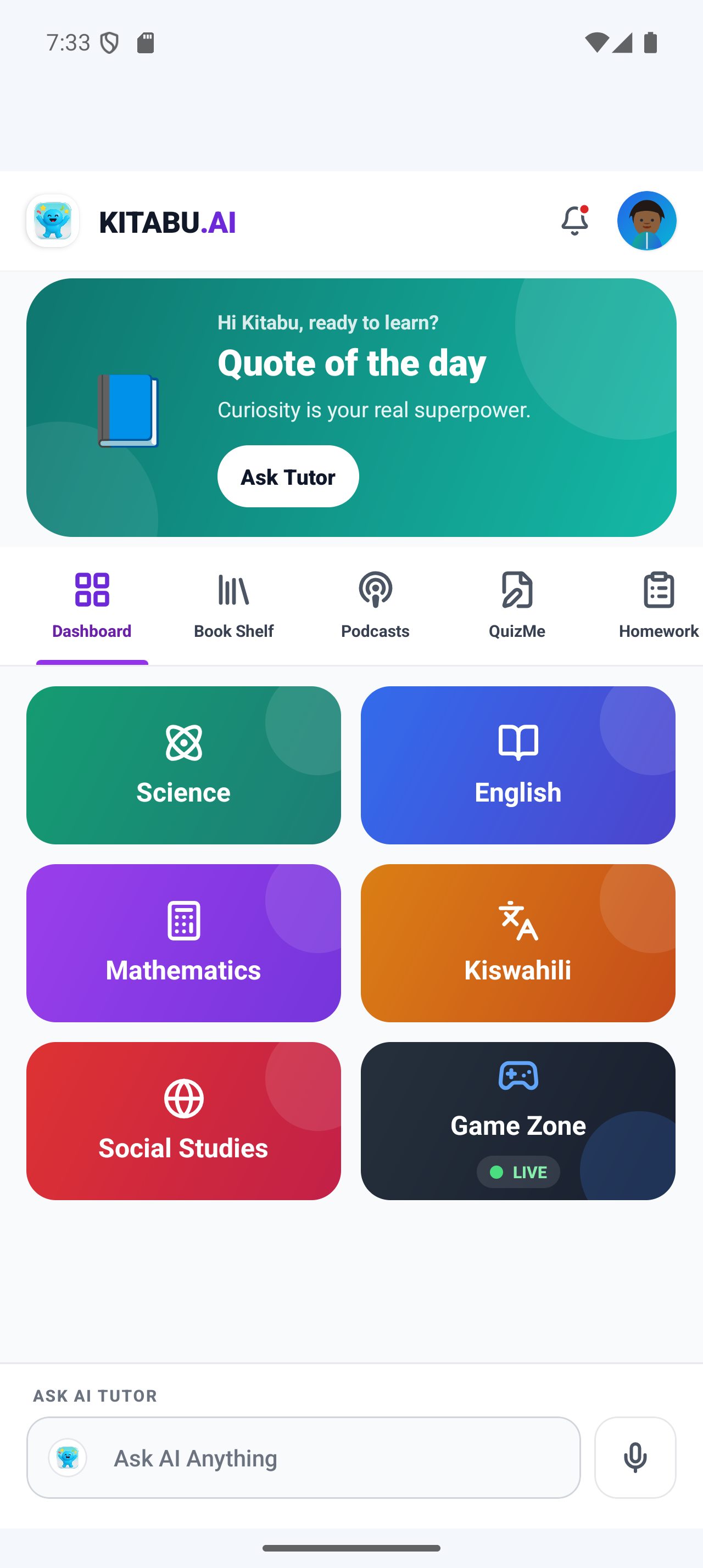
Once the letter is decoded, you need a diagnostic, repair practice, and a way to see the week without nightly prosecution.
Kitabu AI is a patient CBC tutor for Kenyan learners in Grades 1–12, English and Kiswahili. Built by Jambo AI Studio in Nairobi.
Free ≈15-minute diagnostic. Step-by-step help + practice. Parents get a dashboard plus a Friday WhatsApp progress note — visibility without shame.
KPSEA, KJSEA, and KCSE past papers are included from KSh 100/month (list KSh 250) — not a separate panic purchase after the slip. Termly KSh 250 (list KSh 500). Premium KSh 999/term.
1-month free trial. M-Pesa. Android live: Play Store — ai.kitabu.app. iOS/web coming. Same stack covers junior and senior papers when the household has more than one exam class.
Packages: /pricing. Download: /download. Parent framing: /for-parents. Deep guide: KJSEA Grade 9 parents’ guide.
Kitabu will not invent a pathway cut-score for you. It will not pick a senior school. It will help you stop guessing which strand is torn and stop confusing unmarked PDF volume with repair.
Soft CTA: start free this week — no pathway guarantees, no fake testimonials.
Decode first. Then repair. When the house is calm enough to learn, start the 1-month free trial on Android (Play · ai.kitabu.app).
Or WhatsApp +254 716 175 485 / +254 010 886 5757, or email [email protected].
Free to start · M-Pesa · Cancel anytime · English & Kiswahili · Grades 1–12
Common questions
Is an “E” on KJSEA the end of senior school hopes?
No. An E-looking code is a learning-area performance signal inside a wider composite picture. Ask the school how they brief pathways. Do not treat one band as a life verdict.
What do EE, ME, AE, and BE mean?
As widely reported: Exceeding, Meeting, Approaching, and Below Expectation — with sub-levels and points out of 8 per learning area. Confirm on your school’s slip and briefing.
What is the 72-point language parents mention?
Nine learning areas × up to 8 points is commonly described as a 72-point KJSEA aggregate ceiling in public explainers. Use your slip and school briefing as source of truth.
Does KJSEA alone decide everything?
Public explainers commonly describe KJSEA as about 60% of a Grade 10 composite beside KPSEA (~20%) and SBA (~20%). Re-verify weights at decision time. We do not invent cut-scores here.
Should we start a full past-paper marathon tomorrow?
No. Diagnostic first, then marked sections with a mistake log. Volume without repair is theatre — past papers after the red ink.
How do I see if recovery is real?
Teach-back, one artifact, movement on a named strand — not hours with a phone — is my child really revising.
Can Kitabu help if we also have KPSEA or KCSE at home?
Yes. Grades 1–12; KPSEA + KJSEA + KCSE papers included from KSh 100/month; dashboard + Friday WhatsApp; Android live; iOS/web coming; M-Pesa; 1-month free trial.
How much does Kitabu cost?
KSh 100/month (list 250), termly 250 (list 500), Premium 999/term, plus a 1-month free trial — /pricing.