Mathematics
"My child is failing maths." What’s really going on — and the calm way to fix it
The report says “failing maths” — and before you’ve even sat down, someone in the class WhatsApp is already recommending another revision book and a “strict” tutor.
Last updated: 6 September 2026
The report says “failing maths” — and before you’ve even sat down, someone in the class WhatsApp is already recommending another revision book and a “strict” tutor.
Breathe. A weak maths mark in a Kenyan CBC / CBE classroom is rarely laziness, and it is almost never “this child is just bad at maths.” It is usually one or two missing foundations from earlier grades, quietly holding up every topic poured on top. Find those first. Then repair calmly.
The straight answer
Why is my child failing maths but passing other subjects? Maths is unusually cumulative. One missing idea from an earlier grade can quietly sink every topic built on it, while subjects that don’t stack the same way stay fine. Diagnose the missing step before piling on more worksheets from this term’s chapter.
Before you buy another book or book emergency tuition, treat the mark as a map — not a personality label. The job tonight is to find the missing step, not to punish the child into “trying harder” on soft ground.
What a failing grade usually hides
Maths is the most cumulative subject on the timetable.
Fractions feed decimals. Decimals feed percentages. Percentages feed ratio and rate. By Grade 8, half the syllabus stands on foundations poured in Grades 5 and 6.
When one of those foundations never set properly, every topic built on it wobbles. The mark says “failing Grade 8 maths.” The truth is usually “missing two Grade 6 ideas.”
This is different from how most other subjects work — which is exactly why it catches Kenyan families off guard. A child can have a weak week in Social Studies and a strong week the next, with no lasting damage. Maths does not forgive that way.
A gap left unrepaired does not stay the same size. It quietly grows, because every new topic that leans on it inherits the wobble.
How to read a weak maths result on a CBC report
CBC / CBE reports often use performance bands such as BE, AE, ME, EE (Below / Approaching / Meeting / Exceeding Expectation) — sometimes with sub-levels.
On a maths strand, a weak band is not a personality label. It is not “bad at maths forever.”
Treat it as a map:
- Ask the teacher which strand or sub-strand the comment refers to (not only the overall maths grade).
- Ask which earlier ideas that strand assumes (fractions under ratio, place value under decimals, and so on).
- Start repair below the current chapter — not by repeating this week’s worksheet louder.
We are not inventing cut-scores or pathway thresholds here. The school’s key on the report slip is the source of truth.
Your job is to translate “BE on this strand” into “find the missing step,” then act calmly. Same for AE: approaching is still a map of what to shore up — not a verdict on the child.
The foundation chain, concretely
It helps to see one real chain rather than take that claim on faith.
Start at the bottom: counting teaches that numbers represent quantity. Place value teaches that where a digit sits changes what it’s worth — the difference between 24 and 42.
Fractions teach that a whole can be split into equal parts and named by that split. Decimals are fractions written a different way, so a shaky fraction idea produces a shaky decimal idea.
Percentages are decimals scaled to “out of 100” — another fraction in disguise. Ratio compares two quantities using the same reasoning that underpins fractions.
Now take a typical Grade 8 ratio problem: sharing a sum of money between three people in the ratio 2:3:5.
Solving it quietly requires a total of parts, each share as a fraction of the whole, and sometimes a percentage check. A learner who never fully secured Grade 5–6 fraction concepts doesn’t fail because “ratio is hard.”
They fail because the fraction machinery underneath was never built. The exam paper says “ratio.” The real gap says “fractions, two years ago.”
The same chain keeps extending upward. A Grade 9 compound percentage change, or a Grade 10 rates comparison, recombines the same ideas under new vocabulary.
That is why a maths gap left alone for a year or two grows silently. Waiting until “next holiday” often costs more than a calm diagnostic this week — every new topic poured on a soft foundation makes the repair taller later, not shorter.
Three signs it’s a gap, not laziness
Parents often reach for “he’s not trying” before “she’s missing a foundation,” because effort is visible and gaps are not.
Three signs point more reliably at a gap:
- The difficulty is specific to maths. Engaged in English, Science, or Social Studies — but consistently stuck only in maths.
- They can follow the new lesson in class, but fail mixed exercises. Nodding along for one method, then falling apart when five methods mix — usually an older idea the mix assumes is secure.
- The same type of question fails across topics. Word problems fail whether they’re fractions, ratio, or percentage — often a skill underneath all of them, like translating a story into a calculation.
None of these require a specialist. Watch one layer down from the grade: not only “did they pass,” but “which questions, and what do those questions have in common.”
Why trying harder doesn’t work
More hours on this term’s topics can’t fix last year’s gap — it’s like painting a wall that isn’t plumb.
Worse, the child concludes they’re “just bad at maths,” stops asking questions in class, and the gap compounds. Separate effort from diagnosis: the problem isn’t how hard they’re working, it’s where they’re working.
A child who has decided they are “just bad at maths” starts avoiding the subject — sitting quietly instead of asking, guessing instead of showing working, later choosing routes around it.
Unwinding that identity often takes longer than fixing the gap that caused it. Diagnosis first. Sasa, hatujui — we find the missing step before we pile on more of the same.
What a good diagnostic actually asks
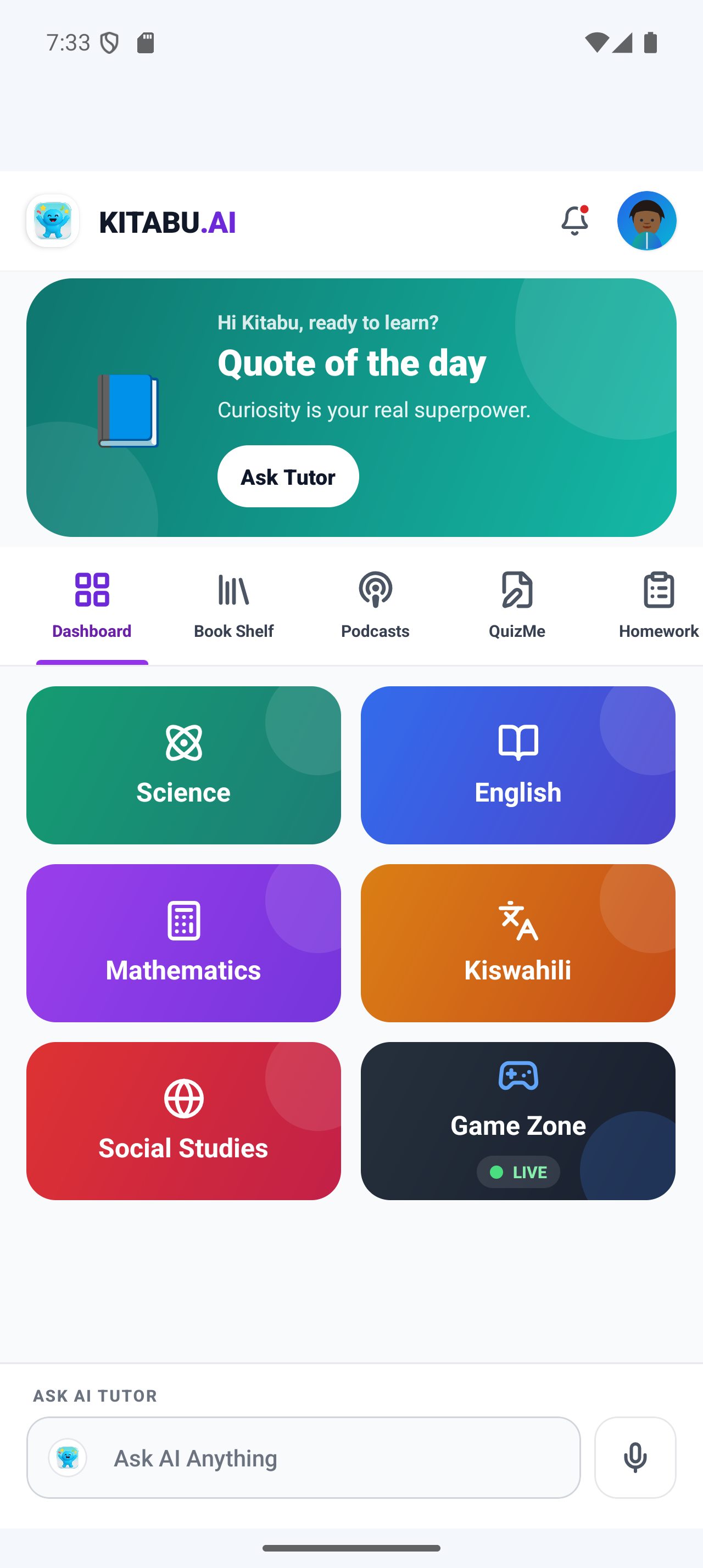
A proper maths check-up doesn’t start with this term’s syllabus.
It walks downward — simple, calm questions from earlier grade levels — until it finds where the child answers confidently and consistently. That point is solid ground. Everything above it is repair focus.
Framing matters. A timed, compared, punitive “test” corrupts the map with anxiety. A curious, judgment-free check-up gets an honest picture.
Kitabu’s free ≈15-minute diagnostic is built as a check-up, not a punishment test.
Say this before any diagnostic: “This isn’t a test you can fail. It’s just us finding out what you already know for sure, so we stop wasting time on things that aren’t actually the problem.”
The calm fix at a glance
| Step | What you do | Why it works |
|---|---|---|
| 1. Find the starting point | Free diagnostic / check-up that maps strands — including earlier grades | Stops guessing and book-buying blind |
| 2. Repair below | Revise the missing earlier ideas in private, patiently | Fixes the wobble under this term’s topics |
| 3. Reconnect to class | Return to current work once foundations hold | Classwork starts making sense without heroics |
| 4. Watch the weekly climb | Dashboard + Friday plain-language update | Progress you can see is progress that continues |
Product UI pattern (illustrative, not a named pilot claim): a Friday note like “improved from 42% to 68% on decimals” changes the mood of a whole household.
That is the shape of the signal — a named topic and a real movement — not a promise of those exact numbers for every child.
Practice that matches CBC working
Once the foundation is under repair:
- Show working the way the teacher expects — process marks matter.
- Mixed exercises after the missing idea is solid — that is where class tests live.
- Past-paper style only when the foundation holds — KPSEA / KJSEA / KCSE maths revision papers are included on Kitabu’s KSh 100/month plan, not a separate add-on.
Evening routine that sits beside maths repair: help with CBC homework. Product twin: CBC mathematics revision.
A term-recovery picture
Week one or two often looks invisible from outside — quiet foundational repetition, little drama in classwork yet.
Around weeks three to six, mixed exercises that used to stall begin to move, and homework time shortens.
By week seven and beyond, for many learners, the foundation holds under new topics, and the home conversation shifts from “why can’t you” to watching a real climb.
Not every child moves on the same calendar. Depth of gap matters. Consistency matters more than drama.
What not to do while repair is happening
- Piling extra worksheets from this term’s topic when the gap sits two grades below.
- Comparing to a sibling or classmate out loud.
- Switching methods every few weeks before any approach finishes mapping the gap.
- Turning every homework night into a courtroom interrogation (umesoma? without a map).
Consistency, even boring consistency, is what lets repair complete.
What to say tonight
Skip “why are you failing?”
Try: “I think there’s one or two old topics playing tricks on you. Let’s find them — it’s not your fault.”
A child who believes the problem is findable will work with you. A child who believes they are the problem will hide.
Weighing human tutors: private tuition alternative. Watching whether revision is real: is my child really revising. Grade 9 maths anxiety near assessment season: KJSEA parents’ guide. Wider junior-school frame: junior school CBC revision.
Where Kitabu fits
When you’re ready to find the real gap, Kitabu AI’s diagnostic is free — no card required.
Kitabu is a patient CBC tutor for Kenyan learners in Grades 1–12, English and Kiswahili. Built by Jambo AI Studio in Nairobi.
It starts with a short check-up that maps solid vs missing strands — including earlier grades — then rebuilds with step-by-step CBC working and practice, not answer dumps.
Parents get a dashboard plus a Friday WhatsApp progress note. You see the week. Tu. The maths conversation at home stops being nightly umesoma? interrogation and becomes a climb you can watch.
KPSEA, KJSEA, and KCSE past papers sit inside the same habit from the KSh 100/month plan (list KSh 250). Termly is KSh 250 (list KSh 500). Premium Package KSh 999/term.
Every student gets a 1-month free trial. Pay later with M-Pesa when you are ready — no USD card drama.
Android is live on the Play Store — ai.kitabu.app. iOS and web are coming.
Pricing: kitabu.online/pricing. Download: kitabu.online/download.
When you want a calm diagnostic and a month of CBC maths practice — without pretending a book alone can find the missing step — start the 1-month free trial on Android (Play · ai.kitabu.app).
Or WhatsApp +254 716 175 485 / +254 010 886 5757, or email [email protected].
Free to start · M-Pesa · Cancel anytime · English & Kiswahili · Grades 1–12
Common questions
Why is my child failing maths but passing other subjects?
Maths stacks. One missing foundation can sink topics above it while other subjects stay fine. Diagnose before more worksheets.
What does BE in mathematics mean for parents?
Usually “below expectation” on a strand, not a life sentence. Ask which strand, which earlier idea it needs, then repair below. Use the school’s report key — we invent no cut-scores.
What about AE — Approaching Expectation?
Same map logic. Approaching means the strand is not yet secure. Find the earlier idea it leans on, repair below, then reconnect to classwork. Still not a personality label.
Is my child just bad at maths?
Almost never. Usually one or two missing earlier ideas. Find and repair them; reconnection is often faster than parents expect.
Should we buy another revision book first?
Diagnose first. A book answers “what exists to study.” It does not answer “what does my child actually not know yet.”
Should I hire a maths tutor or use a learning app?
Either works if it starts by locating the gap rather than repeating this term louder. Calm check-up first; format second.
How long does it take to fix a maths gap?
Depends on depth. Many families see first reconnection signs within a few weeks of consistent repair — not overnight.
What is a maths diagnostic, exactly?
A check-up, not a test. It walks down earlier levels until solid ground appears — that is where repair starts.
Are past papers included on Kitabu?
Yes — KPSEA / KJSEA / KCSE revision papers from the KSh 100/month plan (and every plan).