About
What is Kitabu AI? Every question Kenyan parents ask in 2026
It’s 8:12 PM. The worksheet is open. Your child says “I don’t get it.” You did 8-4-4 — CBC working looks foreign — and the estate tutor’s next slot is Thursday. That gap is why Kitabu exists.
Last updated: 6 September 2026
It’s 8:12 PM. The worksheet is open. Your child says “I don’t get it.” You did 8-4-4 — CBC working looks foreign — and the estate tutor’s next slot is Thursday. That gap is why Kitabu exists.
Not another lecture about “AI in education.” A patient second explanation for home, built for Kenyan strands, with a Friday message you can actually read.
What is Kitabu AI? Kitabu AI is a personal CBC tutor app for Kenyan learners in Grades 1–12, built by Jambo AI Studio in Nairobi. It explains schoolwork step by step in English or Kiswahili, then checks with practice — not answer dumps. Parents get a daily dashboard plus a Friday WhatsApp summary. This season: KSh 100/month (list 250), KSh 250/term (list 500), Premium KSh 999/term, 1-month free trial, KPSEA / KJSEA / KCSE past papers included from KSh 100. Pay with M-Pesa. Android live on Play (ai.kitabu.app); iOS and web coming. Found at kitabu.online — not a bookshop, e-reader, or fintech with a similar name.
The short answer (without the sleepy opener)
Kitabu means book in Kiswahili. Fitting name for a study companion — and also why Google mixes up other brands. More on that below.
What the product does, in plain talk:
- Learner asks a stuck question.
- Tutor explains the CBC way — patiently, again if needed.
- Short practice proves the idea landed.
- Parent sees the week without nightly umesoma? wars.
That is the whole idea. The rest of this page answers what parents ask before they trust an app with a child’s learning and an M-Pesa PIN: what it does, what it costs, who built it, whether it’s safe, what it is not, and how to start without risk.
What Kitabu does for the learner
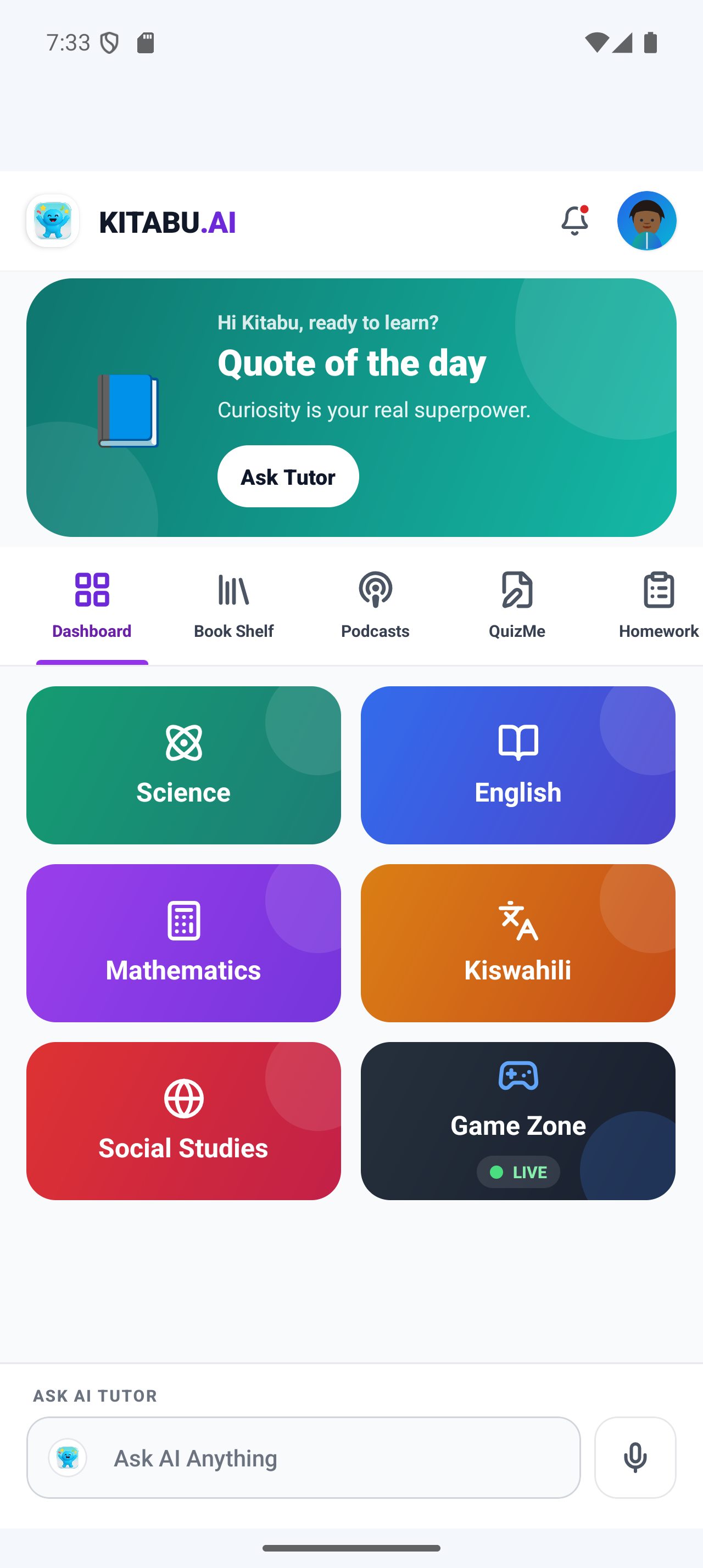
Think of that homework wall: the teacher’s explanation has faded, the worksheet wants working shown a certain way, and nobody at home remembers the CBC method. Shame closes the mouth in class. At home, a child can ask five times.
Kitabu fills that gap. Step-by-step explanation. Then practice — a short quiz or set — because understanding you can’t use fades by morning. Lessons, practice, quizzes, leaderboards and streaks exist so revision feels less like punishment and more like a game they’re trying to win.
Curriculum fit is the point. A generic study tool might teach fractions “a” way. Kitabu teaches them the way the mwalimu expects the working shown and the way assessment rewards. Home explanation and classroom explanation line up instead of quietly competing. Designs follow KICD curriculum; national checkpoints — KPSEA (Grade 6), KJSEA (Grade 9), KCSE — sit in the same Kenyan assessment world.
English and Kiswahili: the idea can land in the language that makes sense tonight.
What parents see (the part that changes the week)
Most learning apps ask you to take the child’s word for it. Kitabu is built so you don’t have to.
Daily dashboard — what was studied, how long they focused, which topics improved, where they’re still stuck. Plain language. Not charts that need a degree.
That view answers the quiet parent question: is my child actually learning, or just holding the phone? Time spent and real progress are not the same thing. Kitabu separates them.
Every Friday, one WhatsApp. Something in this pattern (illustrative product shape, not a named pilot promise): “Mary struggled with decimals this week but improved from 42% to 68%.” Named topic + movement. Enough to act while there’s still time — long before a report card. Deeper on that habit: is my child really revising · parent progress updates.
Basi — you stop guessing. You point energy where the week showed the gap.
What a week with Kitabu looks like
Picture an ordinary school week — not a brochure camp.
Monday: decimals wall during homework. Child asks twice; second time in Kiswahili. Short practice set after.
Wednesday: you glance at the dashboard. Decimals still shaky. One nudge toward another lesson.
Thursday: practice scores climbing.
Friday: WhatsApp tells the honest story in one line.
Nobody needed a two-hour standoff. Nobody had to become a CBC expert overnight. The gap got smaller before it could grow. Small, visible, repeated — that rhythm is the design.
What Kitabu costs this season
Lead price this season: KSh 100 per month (list KSh 250), per learner — less than one revision book, a fraction of one tuition session. Before you pay, a free diagnostic (~15 minutes): friendly check-up, not a punishing test. Maps solid strands vs shaky ones. No card needed to run it.
| Plan | List | This season |
|---|---|---|
| Monthly | KSh 250 | KSh 100 / month |
| Termly | KSh 500 | KSh 250 / term |
| Premium | — | KSh 999 / term |
Every student gets a 1-month free trial. Pay with M-Pesa only when you decide to continue. Cancel anytime.
KPSEA / KJSEA / KCSE past papers are included from the KSh 100/month plan — not a separate add-on.
Full breakdown: /pricing. Principle: real revision should be affordable in shillings, not priced in dollars for a Kenyan family to translate.
Who built Kitabu — and why the name matters
Kitabu AI is built by Jambo AI Studio, Nairobi. Founded by Samora Kibagendi, who set out to solve a problem every Kenyan parent recognises: methods today aren’t the methods we were taught, tuition is expensive, and by the time a report card reveals a gap, the term is over. Fuller story on the founder’s page; team on about.
Disambiguation (please read this once): Kitabu = book in Kiswahili. Because it’s a common word, search results mix in unrelated bookshops, e-readers, and fintech-style services with similar names. Kitabu AI is its own product — tutor app for Kenyan CBC / CBE learners — found at **kitabu.online**, made by Jambo AI Studio. If you arrived looking for a bookshop, an e-book reader, or a payments brand, this isn’t that. This is the schoolwork tutor.
Is Kitabu AI safe?
Yes — and safety is designed in, not bolted on.
Kitabu is a guided, age-appropriate space for schoolwork. Not open-ended browsing where a child wanders the wider internet. Conversations steer back to learning and the syllabus. Parents keep a window through the daily dashboard and Friday summary — nothing about use is hidden from the adults responsible.
Parent consent story, Kenya Data Protection Act approach, and safeguards: /safety. We are not your lawyers; hold every app to a clear consent page you can understand.
What Kitabu is deliberately not
Honesty about limits is part of trust. Here is what Kitabu is not:
- Not a replacement for the teacher. Classroom, syllabus, and mwalimu still do the main work. Kitabu is the patient second explanation for home — support for school, not a substitute.
- Not an answer-dumping shortcut. It won’t finish the homework for them. It explains, then makes the child practise. A completed worksheet a child can’t explain only hides the gap until exam time.
- Not random screen time. Games inside are the revision. Time spent is time you can see, measured against real topics — not open scrolling.
- Not a school portal / SBA marker. It does not grade school projects, upload scores to KNEC, or replace teacher assessment. Revision after red ink is still the family’s job — method in past papers after the red ink.
Is Kitabu AI legit?
Fair question before you hand over a child and an M-Pesa PIN.
Honest answer: Kitabu AI is a genuine product from a named Nairobi company (Jambo AI Studio), with a named founder (Samora Kibagendi), and a real support channel — human at [email protected] or WhatsApp. Clear price in shillings. Free diagnostic before you pay a cent. No card required to try. Legitimacy shows in those details: real company, real price, real way to reach someone, nothing hidden from the parent. Anything that hides those things is what you should be wary of — not this.
Wider buying frame for any tutor app: AI tutor Kenya parents’ guide.
How to start (low risk on purpose)
- Download on Android.
- Run the free diagnostic (~15 minutes) — find the real starting point.
- Pick one subject where tears happen most often.
- Watch the first Friday summary.
- Helping? Continue from KSh 100/month this season with M-Pesa. Not helping? You’ve paid nothing.
One week. One subject. One Friday message you can actually read.
For how AI tutoring fits a Kenyan family — what to demand, what warning signs to avoid — see the complete parent’s guide to AI tutors in Kenya. ChatGPT contrast: ChatGPT vs CBC AI tutor.
Where Kitabu fits — the strong close
Basi. If you want a patient teacher on call for the 8 PM questions — and a Friday note that names how the week really went — Kitabu AI is built for that.
Kitabu is a patient CBC tutor for Kenyan learners in Grades 1–12, in English and Kiswahili. Built by Jambo AI Studio in Nairobi.
It explains step by step, then checks with practice — not copy-paste answers that wreck homework honesty and SBA. Parents get a daily dashboard plus a Friday WhatsApp progress note, so you see the pattern without nightly interrogation.
This season’s pricing
| Plan | List | Current |
|---|---|---|
| Monthly | KSh 250 | KSh 100 / month |
| Termly | KSh 500 | KSh 250 / term |
| Premium Package | — | KSh 999 / term |
Every student gets a 1-month free trial. Pay later with M-Pesa when you’re ready. Cancel anytime.
KPSEA / KJSEA / KCSE past papers are included from the KSh 100/month plan — not a separate add-on.
Platform: Android is live on the Play Store — ai.kitabu.app. iOS and web are coming.
Start free. Read the first Friday update. Vague? Leave — you paid nothing.
If you’d like a patient teacher on call for the 8 PM questions — and a Friday message telling you how the week really went — start the 1-month free trial on Android (Play · ai.kitabu.app).
Or WhatsApp +254 716 175 485 / +254 010 886 5757, or email [email protected].
Tumeshinda the guessing. The Friday line can wait for you — with a named topic attached.
Common questions
How much does Kitabu AI cost?
This discounted season: Monthly KSh 100 (list KSh 250), Termly KSh 250 (list KSh 500), or Premium KSh 999/term. All students get a 1-month free trial. Free ≈15-minute diagnostic, no card needed. Pay with M-Pesa only when you choose to continue. Full table: /pricing.
Is Kitabu AI legit and safe?
Yes. Real product from Jambo AI Studio in Nairobi, founded by Samora Kibagendi. Guided, age-appropriate schoolwork space — conversations stay on learning; parents see the week via dashboard + Friday WhatsApp. Safeguards: /safety. Support: [email protected] or WhatsApp.
Which grades does Kitabu AI cover?
Grade 1 to Grade 12. Lessons follow the CBC (now often called CBE) syllabus strand by strand, so the tutor teaches the way the child is actually assessed at school. Clarifier: CBC vs CBE explained.
Does Kitabu AI work offline?
Downloaded books and saved lessons work offline — a child can keep revising without data. The live tutor (new question, fresh explanation) needs an internet connection.
How do I pay for Kitabu AI?
M-Pesa. Lead price this season KSh 100/month (list 250), with Termly and Premium packages. You only pay after the free diagnostic, once you decide the app is right for your child.
Does Kitabu AI replace the teacher?
No. Patient second explanation for home — supports the classroom, does not replace it. The teacher still teaches, sets work, and assesses. Kitabu helps a child practise until an idea becomes clear.
Are past papers included?
Yes. KPSEA, KJSEA, and KCSE past papers are included from the KSh 100/month plan (and every plan).
Where do I download Kitabu AI?
Android is live: Play Store — ai.kitabu.app. Or start from kitabu.online/download. iOS and web are coming soon.
Is this the same as other “Kitabu” apps or sites?
No. Kitabu is Kiswahili for “book,” so many unrelated products share the word. Kitabu AI (tutor for Kenyan learners) lives at kitabu.online, by Jambo AI Studio. Bookshops, e-readers, and fintech brands with similar names are different products.
Does Kitabu work in Kiswahili?
Yes. Explanations can run in English and Kiswahili so the idea lands in the language that makes sense to the child.